Mechanical concrete polishing in Perth
Polished concrete in Perth
A polished concrete floor is your own slab, ground with diamonds and refined until the concrete itself shines. There's nothing painted or coated on top, so there's no film to peel, yellow in the sun or wear through in the hallway. We polish new and existing slabs across Perth, and every job starts with a free on-site measure and quote.
- Typical Perth price
- $100 to $220 per m²
- Time on site
- Several days for most homes
- First step
- Free on-site measure
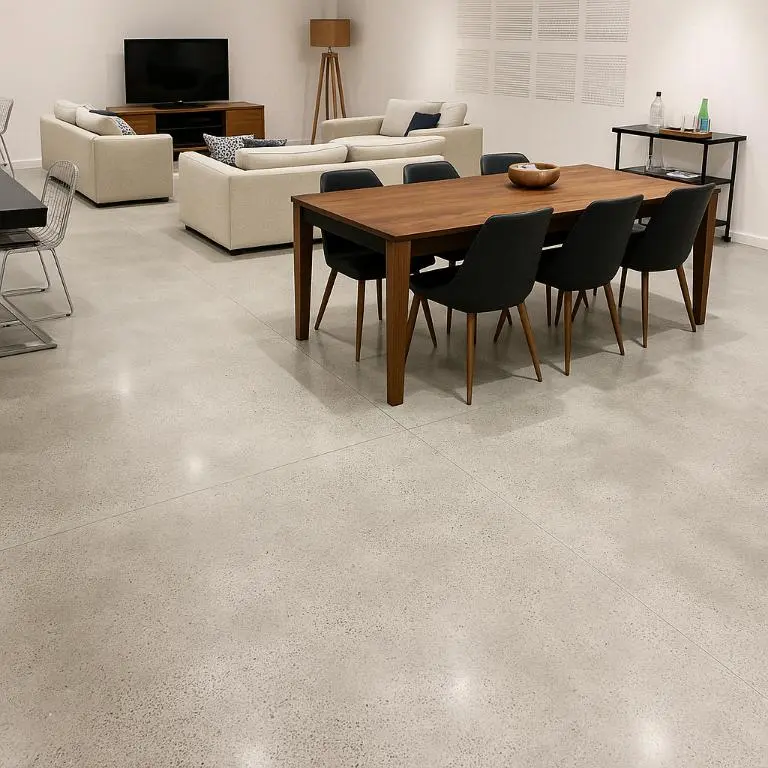
Two choices decide how your floor looks
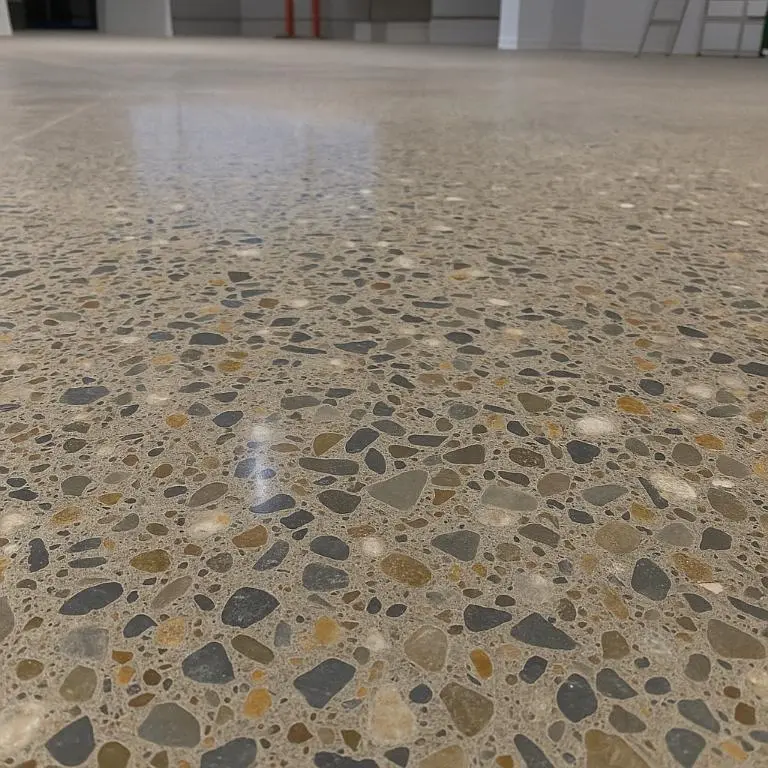
How much stone shows, and how much shine sits on top. The stone is set by how deep we grind, and once it's exposed you can't go back to less. The shine can be changed later by polishing further or stepping back to a lower grit.
How much stone shows
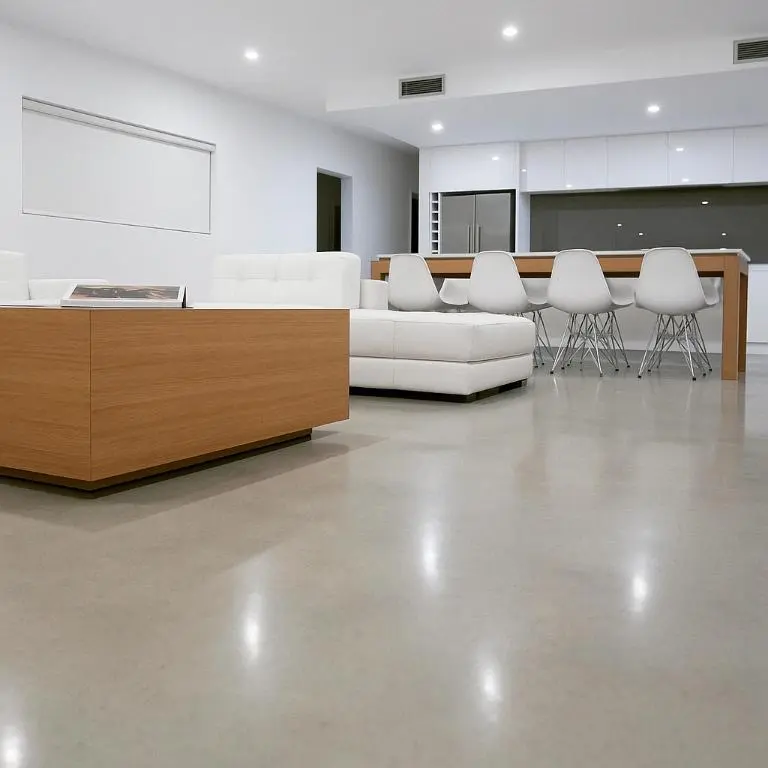
How much shine
Matte
We stop at a lower grit, so the floor has a soft, low reflection. It's forgiving of dust and scuffs and has a little more grip underfoot.
Satin
A gentle sheen that catches light without mirroring it. It's the easiest balance for family homes, where a gloss floor would show every footprint.
Gloss
Refined through the finest grits until windows and pendant lights reflect in it. It looks sharp in big open rooms, shows dust sooner, and gets slippery when wet.
New slab or existing slab?
The process is the same, but what you can expect from the finished floor is quite different.
Building or extending
A polished floor goes best when it's planned before the concrete arrives. Most of what decides the final look happens on pour day: the mix and the stone in it, how flat the slab is finished, and how it's cured. After that, the slab has to survive the build. Plumbers' glue, paint, tile adhesive, rust from steel left lying around and gouges from pallets all end up in the floor you'll be living on.
So talk to your builder, and to us, before the pour. Many builds have the slab ground once before the walls go up, then covered and protected, with the final polish done near handover when the trades have finished.
Under carpet or tiles
Plenty of Perth homes have a slab that's spent decades under carpet or tiles. When that comes up you usually find carpet glue or tile adhesive, a row of gripper holes around the walls, old patches and a few cracks. Glue and adhesive grind off, which is an extra cost. Holes and cracks can be filled, but they normally stay visible as a line that's a little darker or lighter than the floor around it.
Some owners like that history in the floor. If you don't, salt and pepper or full aggregate hides more than a cream polish, and sometimes honed concrete or a coating is the better call. A tip before we visit: lift a corner of carpet inside a built-in robe. It shows us the slab without pulling up a whole room.
How we polish a floor
Polishing happens in stages over several days, and each stage has to be finished across the whole floor before the next one starts. The rooms need to be empty, and there'll be times when nobody can walk on them. We'll tell you up front which days those are, and when furniture can go back.
If you're renovating, have the floor polished before new skirting boards, kickboards and built-in joinery go in. The big machines can't reach right into edges and corners, so those areas are done with smaller hand grinders, and it's much easier to get them right with nothing fixed to the wall.
Where the slab needs old adhesive or coatings taken off first, that's done as a separate concrete grinding stage before the polish begins.
- Grind. Coarse metal-bond diamonds take off the top of the slab to the depth your chosen exposure needs, along with any glue or coating still on it.
- Fill. Grinding opens up small holes and air pockets, and reveals cracks. We fill them with a grout mixed with the floor's own dust so the repairs blend in as far as possible.
- Densify. A liquid densifier soaks into the concrete and reacts with it, hardening the surface so it takes a better polish and wears more slowly.
- Polish. Finer resin diamonds take the floor up through the grits until it reaches the sheen you picked.
- Protect. A thin penetrating guard goes on last to help the floor resist stains from oil, wine and coffee. You won't see it as a layer.
Polished concrete cost in Perth
These are typical 2026 Perth rates for polishing an existing slab. For a 60 m² open-plan living area in salt and pepper, that works out at roughly $7,200 to $10,800.
| Finish | Per m² |
|---|---|
| Cream, nil exposure | $100 to $150 |
| Salt and pepper | $120 to $180 |
| Full aggregate | $150 to $220 |
| Re-polishing an existing polished floor | $40 to $90 |
Where you land in a range comes down to the slab. Removing carpet glue or tile adhesive is usually the biggest extra, and a floor that needs it tends to finish at the top of the range or above it. Small rooms cost more per square metre because setting up the machines takes the same time whatever the size. Lots of cracks to fill, a gloss finish, which takes more passes than matte, and tight spaces with a lot of edge work all add to it. Stairs and steps are priced separately.
Would honed concrete do the job for less?
If a polished concrete quote is more than you'd planned to spend, ask about honed concrete. It's ground to show the stone just like a polish, but it stops before the fine grits and a sealer gives it its finish. In Perth it typically costs $65 to $110 per m², it grips better when wet, and it's the usual choice for alfresco areas and pool surrounds.
The trade-off is upkeep. A sealer wears in busy areas and needs recoating every few years, while a mechanical polish only needs an occasional re-polish. If you already have exposed aggregate outside that has gone dull, we clean and reseal exposed aggregate too.
Living with a polished floor in Perth
Polished concrete is low maintenance, not no maintenance. Most of the wear we see comes from sand.
Sand is the real enemy
Beach and garden sand is harder than the polished surface and works like sandpaper under shoes and chair legs. Put a decent mat outside and inside every door, and dust mop the busy areas daily, more often in summer when the doors are open.
Cleaning
Dust mop or vacuum with a soft head, then damp mop with a pH-neutral cleaner. Skip vinegar, bleach and citrus cleaners. Acid etches the surface and leaves dull patches, so wipe up wine, lemon juice and soft drink rather than letting them sit.
Wet floors
Satin and gloss polished concrete get slippery with water on them. For laundries, the door in from the pool, and anywhere near an outdoor shower, talk to us about a matte finish or an anti-slip treatment.
Sun and summer heat
With no coating on top, there's nothing to yellow in a room that gets afternoon sun. Concrete also holds heat. A shaded slab stays cool through a Perth summer, and winter sun through north-facing glass warms it and comes back out in the evening.
Furniture and pets
Put felt pads on chair and table legs and lift heavy pieces rather than dragging them. Dog claws are far less of a worry than on timber, but grit caught under a paw or a chair leg can still leave fine scratches in a gloss finish.
When it needs a re-polish
A home floor that's kept free of grit can go years before it needs attention. Entries and kitchens dull first, and a light re-polish brings the shine back without grinding the floor again.
Where polished concrete works best
It's at home in open-plan living areas, kitchens and hallways, where it takes heavy foot traffic and a dropped pan without complaint. It works in garages too, as long as you're happy with the odd oil mark. If the garage doubles as a workshop with chemicals or heavy jacks, epoxy flooring holds up better.
For shops, cafés, offices and showrooms, the questions change to slip ratings, trading hours and how much traffic the floor takes in a day. Our commercial polished concrete page covers those. Outside, where a polished finish is too slippery, we usually recommend honed concrete instead.

Polished concrete questions
How long does it take to polish a concrete floor?
Most homes take several days on site. The area, the exposure you choose and how much preparation the slab needs all change that. Full aggregate takes longer than cream because there's more grinding, and adhesive removal adds time before the polish starts. We'll give you a timeframe with your quote.
Can every concrete slab be polished?
Most can, but not every slab will give the look you're hoping for. Soft or weak concrete, heavy cracking, lots of patching or a thin topping laid over the original slab can all limit the result. We check the slab's condition at the free measure and tell you if honed concrete or a coating would suit it better.
Will cracks show in polished concrete?
Yes, to some degree. We fill cracks so they don't catch dirt, but a filled crack still reads as a line in the floor, and a crack that's still moving can open again. Salt and pepper and full aggregate finishes make cracks less noticeable than a cream polish.
Do I need to move out while the floor is polished?
Not always, but the rooms being polished have to be completely empty, and you'll be kept off them during parts of the process. If the job includes the kitchen or the only way through the house, it's often easier to stay elsewhere for those days. We'll talk it through when we plan the job.
Will polished concrete scratch with dogs?
It copes with dog claws far better than timber. Fine scratches mostly come from grit dragged across the surface, by paws or by furniture, and they show more on a gloss finish than on matte or satin. Good mats and regular dust mopping prevent most of it.
How often does polished concrete need re-polishing?
It depends on traffic and how much grit reaches the floor. A home floor that's looked after can go years between visits, while busy entries and kitchens dull sooner. A re-polish refreshes the surface without regrinding and typically costs $40 to $90 per m² in Perth.
Can you polish a slab with underfloor heating?
Yes, and polished concrete works well with hydronic or electric heating cast into the slab. We need to know how deep the pipes or cables sit before we start, because that limits how far we can grind. On a new build, tell your builder you want a polished finish so the heating is laid with enough concrete cover above it.
Free on-site measure and quote
Book your free measure
Send us a few details and we'll be in touch to arrange a time to look at your slab, measure up and price the finish you want. There's no cost and no obligation.
What helps us quote
Whether the slab is new or existing, roughly how many square metres, and the look you're after: cream, salt and pepper or full aggregate. If the floor is under carpet or tiles now, say which.
Tell us about your floor
All fields are needed so we can get back to you.